
nashi Team
5 min read
“Terminal pricing” in Singapore sounds simple until you ask for a quote. One provider gives you a low card rate but charges rental. Another offers “free” hardware but adds monthly platform fees, minimums, or GST on top. If you are a micro or small business, those extras can matter more than a 0.2 percent difference in headline rates.
This guide breaks terminal pricing down into the components that actually hit your P&L: fees, rentals, and the hidden costs that change your effective rate. It is written for Singapore merchants who accept (or want to accept) in-person card payments, especially retailers, pop-ups, mobile service providers, and professional services.
What “terminal pricing” usually means in Singapore
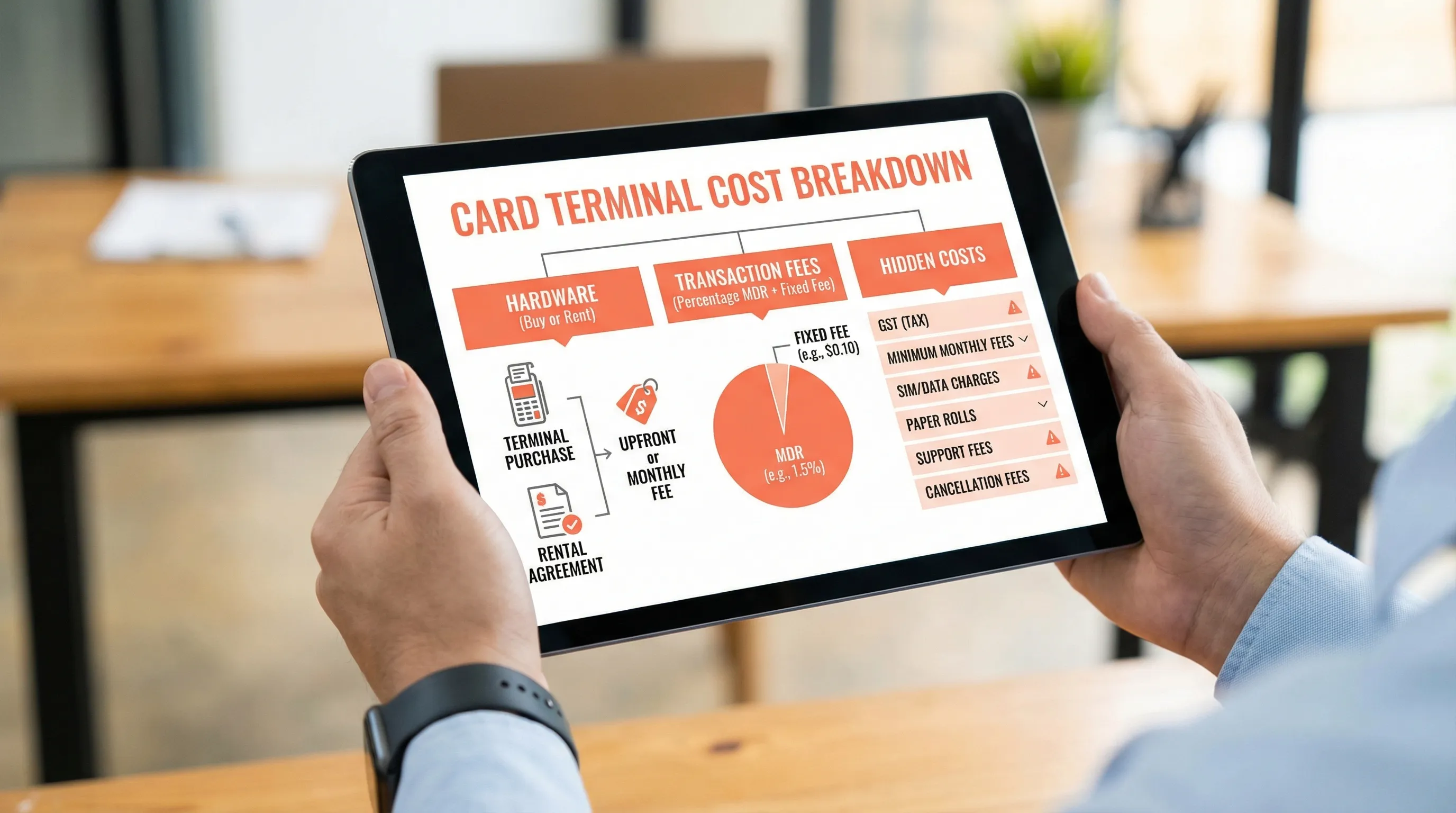
When people say “terminal pricing”, they often mix three separate things:
The hardware cost: buying a terminal upfront, or renting it monthly.
The processing cost: the percentage fee taken from each transaction (often called MDR, merchant discount rate), sometimes with a fixed per-transaction fee.
The operational cost: everything around it, SIM plans, paper rolls, support, replacement, cancellation, and cash-flow impact from settlement timing.
A useful way to think about it is: terminal pricing is not one number, it is your total cost of acceptance.
The most common pricing models you will see
Singapore merchants typically encounter these models when shopping for terminals and in-person card acceptance.
Model | What you get | How pricing usually appears | Best fit | Common downside |
|---|---|---|---|---|
Traditional countertop terminal (bank or legacy provider) | A dedicated device that lives at your counter | Rental or purchase + processing fees | Fixed-location businesses that want a dedicated checkout device | Can come with longer onboarding, paperwork, and ongoing fees |
Mobile card reader (Bluetooth mPOS) | Small reader paired to a phone/tablet | Reader cost (or rental) + processing fees | Small retail, pop-ups, mobile sellers | Bluetooth pairing issues, battery management, replacement cost |
All-in-one POS terminal | Terminal plus POS software (often with inventory) | Higher monthly software fees + processing fees | Retailers who truly need POS features | You may pay for features you do not use |
Tap-to-Phone (SoftPOS) | No hardware, your phone becomes the terminal | Processing fees, usually no device rental | Mobile services, intermittent selling, first-time card acceptance | Not ideal for very low-value, high-frequency transactions |
This article focuses on the pricing logic you will see in terminal quotes, but it also highlights when hardware-free Tap-to-Phone can reduce your total cost.
The fee components to look for in any terminal quote
Most surprises come from what was not discussed upfront. When comparing providers, ask them to state each item clearly.
1) Transaction fees (MDR and fixed fees)
This is the headline number merchants fixate on, for example “2.5%”. In reality, many plans combine:
A percentage fee (MDR): taken from the transaction amount.
A fixed fee: charged per approved transaction, for example S$0.20 to S$0.65.
The fixed fee matters a lot when your average bill is small. On a S$6 coffee, a S$0.50 fixed fee is huge. On a S$300 tuition package, it is almost irrelevant.
2) Terminal rental, subscription, or device purchase
A rental looks small, until you annualise it and multiply by the number of devices. Also clarify whether the plan requires:
One terminal per outlet, or per cashier
Extra fees for additional terminals
Minimum rental term (and whether early cancellation triggers fees)
If your business is seasonal (bazaar brand, festive pop-ups), “12-month rental with penalties” can become your biggest hidden cost.
3) Setup, installation, and onboarding charges
Some providers charge a setup or onboarding fee. Even when setup is advertised as S$0, ask whether there are payable items such as:
Delivery, installation, or training
Account activation fees
Replacement fees if documents expire and re-verification is required
4) Connectivity costs (SIM/data)
Many terminals are sold as “4G terminals”, which really means “a terminal plus a data plan”. Confirm:
Whether data is included or billed separately
What happens if you exceed a data limit
Whether the terminal supports WiFi as a backup
5) Consumables and maintenance
The small items add up across a year:
Receipt paper rolls (if you print receipts)
Maintenance, servicing, or swap-out fees
Damage and loss fees
Battery degradation over time (for portable terminals)
6) Settlement timing and payout rules
Settlement speed is not just a convenience issue, it affects working capital. For example, if you must pay suppliers within a week, a longer settlement cycle can force you to hold more cash.
Ask:
Payout timeline (for example T+2 business days)
Whether weekends and public holidays delay payouts
Whether there are fees for faster payouts
7) Disputes, chargebacks, and “admin” fees
Chargebacks are not common for every merchant, but when they happen, they are expensive in time and sometimes in fees.
Even if you cannot avoid them fully, you can avoid nasty surprises by asking what is charged for:
Chargeback handling
Retrieval requests
Evidence submission windows and process
8) GST treatment
In Singapore, whether you pay GST depends on what is being charged and whether the provider is GST-registered. Some providers apply GST on top of fees, others may not, and it changes your effective cost.
Always ask the provider to show:
Fees before GST
Fees after GST
The “hidden costs” that change your effective rate
Two merchants can both be quoted “2.5%”, yet one ends up paying far more.
Card mix: local vs international, and AMEX
If you serve tourists, expats, or cross-border customers, your real MDR is driven by your card mix. International cards and AMEX often price differently than Singapore-issued Visa and Mastercard.
That matters for:
Airport transfers and private drivers
Tourist-facing retail
Premium services (wellness, physio, clinics)
Cross-border logistics and movers
If you only compare “local card rate”, you are not comparing terminal pricing properly.
Minimum monthly fees and minimum transaction counts
Some plans only work if you process enough volume. A low MDR can be paired with:
Monthly minimum service fees
Minimum transaction volume requirements
Higher rates if you fall below a threshold
If you are a micro business doing intermittent events, this is one of the most important questions to ask upfront.
Multiple terminals and staff workflows
One common budgeting mistake is assuming “one terminal for the whole business.” In practice:
A shop with queues may need two terminals.
A clinic may want one device per receptionist.
An events team might need one device per booth.
Terminal rental or device purchase costs scale with each unit, even if your transaction volume does not.
Contracts and early termination
Terminal deals sometimes include a commitment period. The cost is not just “monthly rental”, it is “monthly rental multiplied by the months you cannot escape.”
Before signing, get the cancellation terms in writing and understand:
Lock-in period
Notice period
Early termination fees
Whether you must return hardware in working condition
A simple way to compare terminal pricing: calculate your effective rate
When comparing options, compute a single number that reflects your real cost.
Effective rate (%) = (Total monthly fees + total transaction fees) ÷ Total monthly card sales
Here is a comparison template you can use with your own numbers.
Input you should estimate | Example placeholder | Why it matters |
|---|---|---|
Monthly card sales | S$8,000 | The denominator for your effective rate |
Number of card transactions | 120 | Drives fixed per-transaction fees |
Average transaction size | S$66.67 | Reveals whether fixed fees hurt you |
Terminal rental / monthly subscription | S$30 | Can dominate costs for low volume |
MDR on local cards | 2.5% | Drives the bulk of fees for high ticket |
Fixed fee per transaction | S$0.30 | Punishes low-value payments |
Share of international/AMEX | 10% | Raises blended MDR |
If a provider will not help you model this, that is a signal by itself.
What terminal pricing looks like for Tap-to-Phone (and why it can be cheaper)
For many micro businesses, the biggest “hidden cost” of terminals is hardware itself: rental, lock-in, replacements, and logistics. Tap-to-Phone removes that layer by turning an NFC-capable phone into the acceptance device.
For context, nashi is a Tap-to-Phone card acceptance app built for micro and small businesses in Singapore. It is:
Hardware-free, no terminals or accessories required
Available on Android today, with iOS coming soon
Accepts Visa, Mastercard, and AMEX
PCI-DSS compliant, powered by Adyen infrastructure
Offers fee-free transactions up to S$1,000 as a free trial
Settles payouts to your bank account in 2 business days
Supports full or partial refunds in-app
nashi’s current public list pricing (for card acceptance) includes:
2.4% for businesses new to card payments
2.7% for other categories
And nashi may offer sharper pricing for selected segments based on industry and maturity.
The key point for terminal pricing comparisons is this: if you do not need a dedicated device on the counter every day, removing terminal rental can meaningfully reduce total cost and commitment.
When paying for a traditional terminal can still be the right call
Hardware-free is not automatically better for every merchant. A traditional terminal (or a full POS) can be worth the cost if you have operational needs that justify it.
Common cases where a dedicated terminal makes sense:
Very low-value, high-frequency transactions, where fixed fees and speed of throughput matter most (for example, busy F&B)
Multiple staff and a fixed counter workflow, where a dedicated device reduces confusion
You require printed receipts by default, and do not want to rely on SMS or email receipts
You want a “single-purpose” device that staff cannot use for anything else
If this sounds like your business, focus your terminal pricing evaluation on the contract terms, replacement policy, and how fees change by card type.
Questions to ask providers so you do not get surprised later
Use these questions when you request a quote. They are designed to flush out hidden costs quickly.
What is the all-in MDR for Singapore-issued Visa, Singapore-issued Mastercard, AMEX, and international cards?
Is there a fixed fee per transaction, and is there a minimum fee per sale?
Is the terminal rented or purchased, and what is the lock-in period?
Are there setup, delivery, or training fees?
Is SIM/data included, and what happens if connectivity fails?
Are there any monthly minimum fees or volume thresholds?
What is the settlement timeline, and are payouts delayed on weekends/holidays?
What are the cancellation, early termination, and replacement policies?
If a provider answers vaguely, ask for the full fee schedule in writing.
A practical approach for Singapore SMBs: match your payment stack to your customers
In Singapore, many micro businesses already use PayNow because it is fast and familiar for locals. The problem is that PayNow is not usable for most international customers, and many customers still prefer tapping a card or mobile wallet.
A simple approach is:
Keep PayNow for zero-fee local transfers.
Add card acceptance for customers who want to tap (especially tourists and higher-value services).
If you want a deeper refresher on PayNow QR setup, see nashi’s guide to creating a PayNow UEN QR code. And if you are evaluating hardware-free acceptance specifically, nashi also published a practical walkthrough on how to use Tap to Pay on your smartphone.
Choosing the best option: a quick decision rule
If your business is fixed-location, high throughput, and low ticket size, a traditional terminal may be worth its monthly cost.
If your business is mobile, appointment-based, seasonal, or you simply do not want to commit to terminal rental, Tap-to-Phone is often the simplest way to control terminal pricing and remove hardware-related hidden costs.
To explore a terminal-free option, you can start with nashi’s free trial and test real transactions in your environment: nashi.
For iPhone users watching this space, Apple launched Tap to Pay on iPhone in Singapore in December 2025. You can read the announcement on the Apple Newsroom.


