
nashi Team
8 min read
Picking the right way to take credit card payments can make or break a small business in Singapore. For a brick-and-mortar shop, a classic terminal might be perfect. For a pop-up stall, a nimble Bluetooth reader or a hardware-free app like nashi could be the ticket.
Your Guide to Singapore’s Payment Landscape
If you're not accepting credit cards, you're leaving money on the table. It’s no longer a complicated, expensive process for big retail chains only. Today, accepting card payments is easy, affordable, and non-negotiable for grabbing every possible sale.
Singapore's card payments market is set to jump by another 6.2% in 2025, hitting SGD158.2 billion. Credit cards make up 39.18% of all point-of-sale value (SGD55.14 billion). Customers prefer cards for bigger purchases to rack up points and miles.
This creates a huge opportunity for small businesses like pop-up vendors, freelancers, and home-based businesses. Card payments are no longer out of reach. You can see more stats over at Economy Global.
Matching the Reader to Your Business
Let's review the main types of credit card readers in Singapore. Each one is designed for a different way of doing business.
Traditional Bank Terminals: These are the sturdy machines you see at supermarkets. They are reliable but often come with rental fees and binding contracts.
Mobile Bluetooth Readers: These small gadgets connect to your phone or tablet. They’re fantastic for mobile businesses like food trucks or delivery drivers.
SoftPOS or 'Tap to Phone' Apps: This technology turns your smartphone into a payment terminal with no extra hardware. It's a game-changer for solo entrepreneurs who want to start accepting cards without any upfront cost.
A traditional terminal is like a landline phone—rock-solid but stuck in one place. A 'Tap to Phone' app is your smartphone—powerful, flexible, and goes wherever you go.
By the end of this guide, you’ll know exactly what you need to make getting paid the easiest part of your day.
The Four Main Types of Credit Card Readers in Singapore
Choosing the right credit card reader for your business in Singapore comes down to four main types. Each is designed for a different business model. Getting this choice right from the start makes life much easier for you and your customers.
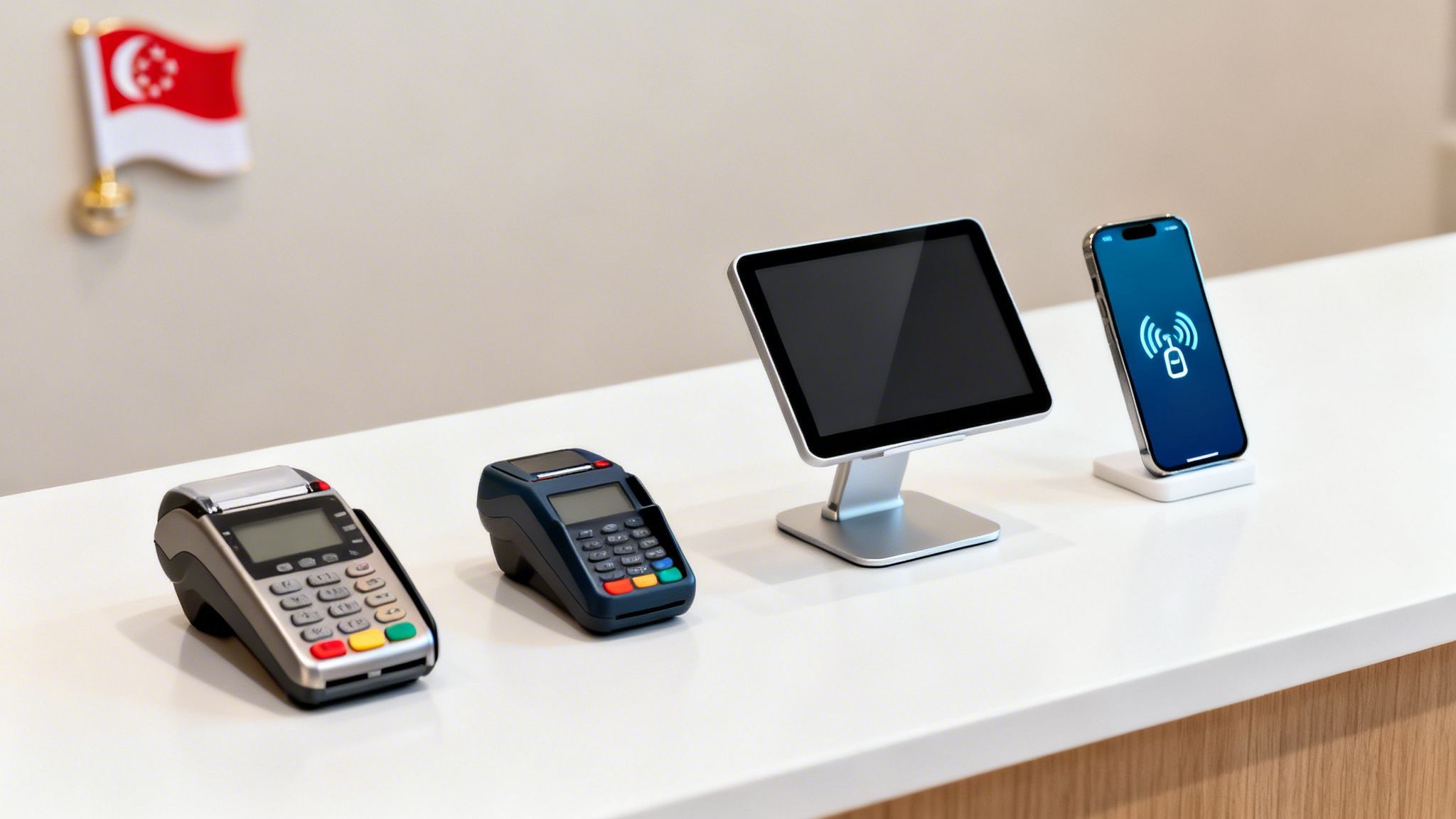
We'll walk through each option, breaking down what they do best and who they're for. The goal is to find the perfect match for your daily operations.
1. Traditional Bank Terminals
These are the reliable terminals on the counters of supermarkets and large retail chains. Offered by major banks like UOB or OCBC, these machines connect directly to your business bank account. They are built to handle a constant stream of transactions.
However, this reliability comes with a catch. Banks often require a rental contract with a monthly fee. The sign-up process can also be slow, involving lots of paperwork and waiting for installation.
2. Portable Bluetooth Readers
These small, handheld readers pair wirelessly with your smartphone or tablet. They are compact enough to fit in your pocket. This gives you the freedom to take payments anywhere.
This setup is ideal for:
Pop-up shops and market stalls.
Cafes and restaurants offering tableside payments.
Mobile service pros like plumbers or personal trainers.
They are usually cheaper to start with than traditional terminals and often have flexible, pay-as-you-go pricing.
3. Integrated Point-of-Sale (POS) Systems
An integrated POS is the command centre for your entire business. It combines payment processing with inventory tracking, sales reports, and customer loyalty programs. It's much more than just a card reader.
These all-in-one solutions are perfect for established F&B outlets and retail stores. They are powerful but require a larger investment in hardware and monthly software fees.
Want to explore this further? Check out our deep-dive guide on the best mobile POS systems in Singapore for 2026.
4. SoftPOS or 'Tap to Phone' Apps
SoftPOS (Software Point of Sale) turns a regular smartphone into a payment terminal. No extra hardware is needed. At all.
With an app like nashi, you can securely accept contactless payments from Visa, Mastercard, and AMEX. The customer simply taps their card or phone on the back of your phone.
This technology completely removes the hardware problem. There's nothing to buy, rent, or break. It’s the easiest way for a new or small business to start accepting cards.
This hardware-free approach is perfect for micro-merchants and freelancers who want a professional solution with zero upfront cost.
Comparing Costs, Features, and Trade-Offs
Picking a credit card reader is a major decision for your business. The right choice streamlines sales and saves you money. The wrong one leads to hidden fees and clunky processes.
The decision often involves a trade-off. You can pay for hardware upfront or accept higher fees on each sale. You can also choose between a slow, paper-based setup and a modern digital onboarding.
Upfront Costs vs. Transaction Fees
You must decide whether to pay more now or more later. Traditional terminals from banks may offer lower transaction rates but come with monthly rental fees or a high purchase price. This is a major barrier for new businesses.
Modern providers, especially SoftPOS apps like nashi, have zero hardware costs. You just pay a straightforward, per-transaction fee. This pay-as-you-go model is perfect for businesses with unpredictable sales.
A traditional terminal is like buying a car, with a big upfront cost and ongoing maintenance. A hardware-free app is like using Grab—you only pay for the trips you take.
Taking card payments is essential. Singaporeans' unpaid credit card balances hit a 10-year high of S$9.07 billion. Get the full story on these financial trends and read the detailed analysis from Channel NewsAsia.
Onboarding Speed and Contract Lock-In
How fast can you start taking payments? For a pop-up stall or a freelancer, speed is everything. Traditional banks and larger POS providers can make you wait weeks, drowning you in paperwork.
Digital-first solutions are built for speed. Many SoftPOS providers have a completely online application you can finish in minutes. Approval often comes within one or two business days.
Also, beware of contracts. Many providers will try to lock you into a 12 or 24-month contract. Hunt for solutions that offer no lock-in contracts to maintain flexibility as your business grows.
Feature Comparison Across Singapore Payment Providers
This table breaks down the key differences between payment solutions in Singapore. It will help you see which one truly fits your business.
Provider Type | Hardware Costs | Onboarding Speed | Contract Lock-in | Best Use Case |
|---|---|---|---|---|
Traditional Banks | High (rental/purchase) | Slow (weeks) | Common (12-24 months) | High-volume, fixed-location retail, franchise chains |
Portable Readers | Low to Moderate | Moderate (days to a week) | Varies | medium sized businesses, F&B cafes |
SoftPOS Apps | None | Fast (1-2 business days) | Rare (no lock-in) | Micro-merchants, mobile businesses, pop-ups |
Understanding these trade-offs is key. While a busy retail shop might prefer a bank terminal, the agility of hardware-free solutions is a better match for modern entrepreneurs. If you're weighing your options, check out our guide on some popular HitPay alternatives.
The Rise of Hardware-Free Tap to Phone Payments
You can accept Visa, Mastercard, and AMEX payments using only your smartphone. This technology is called Tap to Phone, also known as SoftPOS. It completely eliminates the need for external card readers.
Your phone becomes the payment device. A customer just taps their contactless card or smartphone on the back of your phone. The payment is instant, secure, and simple.
This approach is perfect for modern, mobile-first businesses in Singapore. If you're a personal trainer, a market vendor, or a freelance consultant, you are free from extra gear. Your business is wherever your phone is.
How Does Tap to Phone Technology Actually Work?
SoftPOS solutions like nashi use your phone’s built-in Near Field Communication (NFC) chip. This is the same secure tech that powers Apple Pay and Google Pay. The NFC chip securely captures encrypted payment details when a customer taps their card.
The transaction is protected by multiple layers of security, meeting the same standards as traditional terminals. Card details are never stored on your phone.
Tap to Phone gives the smallest businesses the same power to take cards as a major retail chain. It achieves this without the cost or complexity.
Digital payments in Singapore are projected to hit 92.0% by 2025. Hardware-free SoftPOS allows businesses like food trucks and startups to enter this market instantly. Solutions like nashi offer clear pricing, making it a simple choice. You can learn more from this Singapore's payment landscape with this great report from PwC.
Why Hardware-Free Is Such a Big Deal
Ditching hardware solves major headaches for small merchants. It removes the barriers that have stopped them from accepting cards.
Zero Upfront Cost: You don’t buy or rent a terminal, saving hundreds of dollars.
Instant Onboarding: The digital sign-up is usually completed within one business day.
Ultimate Portability: Your payment system is as mobile as you are.
No Maintenance Headaches: There are no extra devices to charge, connect, or break.
This approach lets business owners focus on serving customers and making sales. It aligns with a modern business model that values being nimble and keeping overheads low. For more details, see our guide on how Tap to Pay on iPhone works.
Your Checklist for Choosing a Card Reader
Picking the right payment solution is easier if you break it down into a few simple questions. This checklist will help you create a profile of your business needs. Once you have that, finding the perfect match is simple.
How Does Your Business Actually Work?
First, think about the "where" and "how" of your daily sales. Your operations are the biggest clue to what you need.
Where do you make your sales? For a fixed location like a shop, a countertop terminal might work. If you're mobile—a personal trainer or pop-up vendor—you need a portable solution like a Bluetooth reader or a 'Tap to Phone' app.
How often do you take card payments? A busy café needs a system that’s always on. If you're a freelancer invoicing a few clients a month, a solution with low or zero monthly fees makes more sense.
Who Are Your Customers and What Are They Buying?
Next, consider your customers and your sales. Transaction value and volume help determine which fee structure saves you the most money.
The goal is to match your payment system to your customer's habits and your average sale size. This protects your profit margins and keeps things convenient.
Answering these questions will provide clarity:
Who are your typical customers? If you serve tourists, accepting international credit cards like Visa and Mastercard is non-negotiable.
What’s your average sale size? For small, frequent purchases, a simple flat-rate fee is easy to manage. For larger sales, finding the most competitive percentage-based rate is critical.
What’s your monthly sales volume? Some providers offer lower rates only if you hit a high monthly sales target. A solution with a fair, straightforward rate from your first sale is often a safer bet.
So, Why Is nashi a Game-Changer for Small Businesses?
Traditional credit card readers in Singapore often felt designed for someone else. The high costs, confusing contracts, and clunky hardware were major hurdles. This is where nashi changes the game for sole traders and on-the-go entrepreneurs.
The approach is simple and designed by someone who understands small business pain points. nashi focuses on solving the exact frustrations that kept merchants stuck with "cash only" signs.
No Hardware, No Headaches
The biggest win is ditching physical hardware completely. With nashi, your smartphone is the payment terminal, thanks to Tap to Phone tech. This means zero upfront cost, no monthly rental fees, and no dropped Bluetooth connections.
This hardware-free approach is ideal for businesses on the move. Pop-up shops, mobile hairdressers, and market vendors can finally accept professional payments without extra gear.
Get Started in Just a Day
Forget weeks of paperwork or waiting for a terminal to be delivered. The sign-up for nashi is digital and fast. Most accounts are approved in just one business day.
Think of nashi as the perfect partner to your existing PayNow. Keep using PayNow for local transfers, and add nashi to accept payments from tourists or anyone with a credit card.
This speed is a huge advantage. Best of all, there are no lock-in contracts. You have the freedom to use the service when it makes sense for you, with no long-term pressure.
Designed for the Modern Hustle
nashi closes the gap between being a cash-only business and professionally accepting card payments. It’s made for entrepreneurs who need a simple, reliable way to never miss a sale.
This is especially true for capturing sales from tourists or for larger items where customers prefer using a credit card. By removing the old barriers of cost and complexity, nashi makes card payments a practical option for every small business in Singapore.
Frequently Asked Questions
Is “Tap to Phone” technology secure?
Yes, it is extremely secure. Tap to Phone uses the same encrypted Near Field Communication (NFC) technology that powers Apple Pay and Google Pay. Sensitive card details are never stored on your phone, and the system meets the same security standards as traditional terminals.
I already use PayNow. Do I still need this?
PayNow is great for local bank transfers, but it doesn't serve everyone. You need a card reader to accept payments from tourists with international cards or from locals who want to earn credit card rewards. Adding card payments plugs a crucial gap and ensures you never lose a sale.
How quickly will I receive my money?
This varies by provider. Traditional banks can take two or three business days to settle funds. Newer, digital-first solutions like nashi understand that cash flow is critical and typically deposit your money into your bank account in just one business day.
Can I accept payments from tourists with foreign cards?
Absolutely. Modern card readers and apps are designed to accept major international cards like Visa, Mastercard, and American Express. This is essential for any Singapore business that serves tourists, expats, or international clients.
Ready to stop worrying about hardware and start taking card payments? nashi turns your phone into a secure payment terminal in minutes. You can be up and running as soon as the next business day. Get started at trynashi.com.


