
nashi Team
5 min read
For many Singapore small businesses, PayNow is the default digital payment method. It is familiar, low-cost, and convenient for local customers. But the moment you serve tourists, newly arrived expats, overseas clients, or regional visitors, PayNow can stop being enough.
That is where international card payments become important. If a customer does not have a Singapore bank account, they may not be able to use PayNow at all. If they are buying a higher-value package, they may prefer a credit card for points, cashflow, chargeback protection, or simply habit. For merchants, the question is not whether cards should replace PayNow. The better question is: when does adding card acceptance help you win sales you would otherwise miss?
This guide explains how international card payments work for Singapore small businesses, when they are worth accepting, what costs to look out for, and how to start without buying a traditional payment terminal.
What “international card payments” means in Singapore
For an in-person Singapore business, an international card payment usually means a customer pays with a Visa, Mastercard, or Amex card issued outside Singapore. The card may be a physical contactless card, or it may be stored in a mobile wallet such as Apple Pay.
In most small business scenarios, you are still charging in Singapore dollars. The customer’s card issuer handles the foreign exchange conversion and displays the final amount to the cardholder based on their own bank or wallet terms. Your business receives settlement in your local merchant account or bank account according to your payment provider’s payout schedule.
This is different from PayNow. PayNow is a Singapore bank-to-bank transfer service. It works very well for local customers with participating Singapore bank accounts, but it is not designed as a universal payment method for overseas visitors. A tourist from Australia, a newly arrived expat, or a Malaysia-based client may not be able to scan your PayNow QR and pay from their own bank app.
It is also different from online cross-border payments. This article focuses on in-person international card payments, such as a customer tapping a foreign-issued card at your pop-up booth, clinic, home service appointment, private transport pickup, or showroom.
Why international cards matter more than many small businesses realise
Singapore is a highly digital payments market, but “digital” does not mean every customer can use the same method. Local customers may be happy with PayNow. International customers usually expect cards.
This matters most when the transaction is high enough that losing even a small number of sales hurts. If you sell S$8 drinks at a hawker-style stall, card fees may be too painful compared with PayNow or cash. But if you sell S$180 skincare bundles, S$400 air-con servicing packages, S$900 tuition packages, S$1,200 private transport arrangements, or S$2,000 furniture orders, the economics look very different.
Card acceptance can help in situations where customers want:
A familiar payment method while travelling
Credit card rewards, miles, or cashback
A way to pay without a local bank account
A receipt trail for business or travel expenses
More flexibility for higher-value purchases
For Singapore merchants, the benefit is not only “more payment options.” It is reducing friction at the exact moment the customer is ready to pay.
If you want a broader view of local payment choices, nashi has a separate guide to mobile payment methods in Singapore, including PayNow, cards, and wallets.
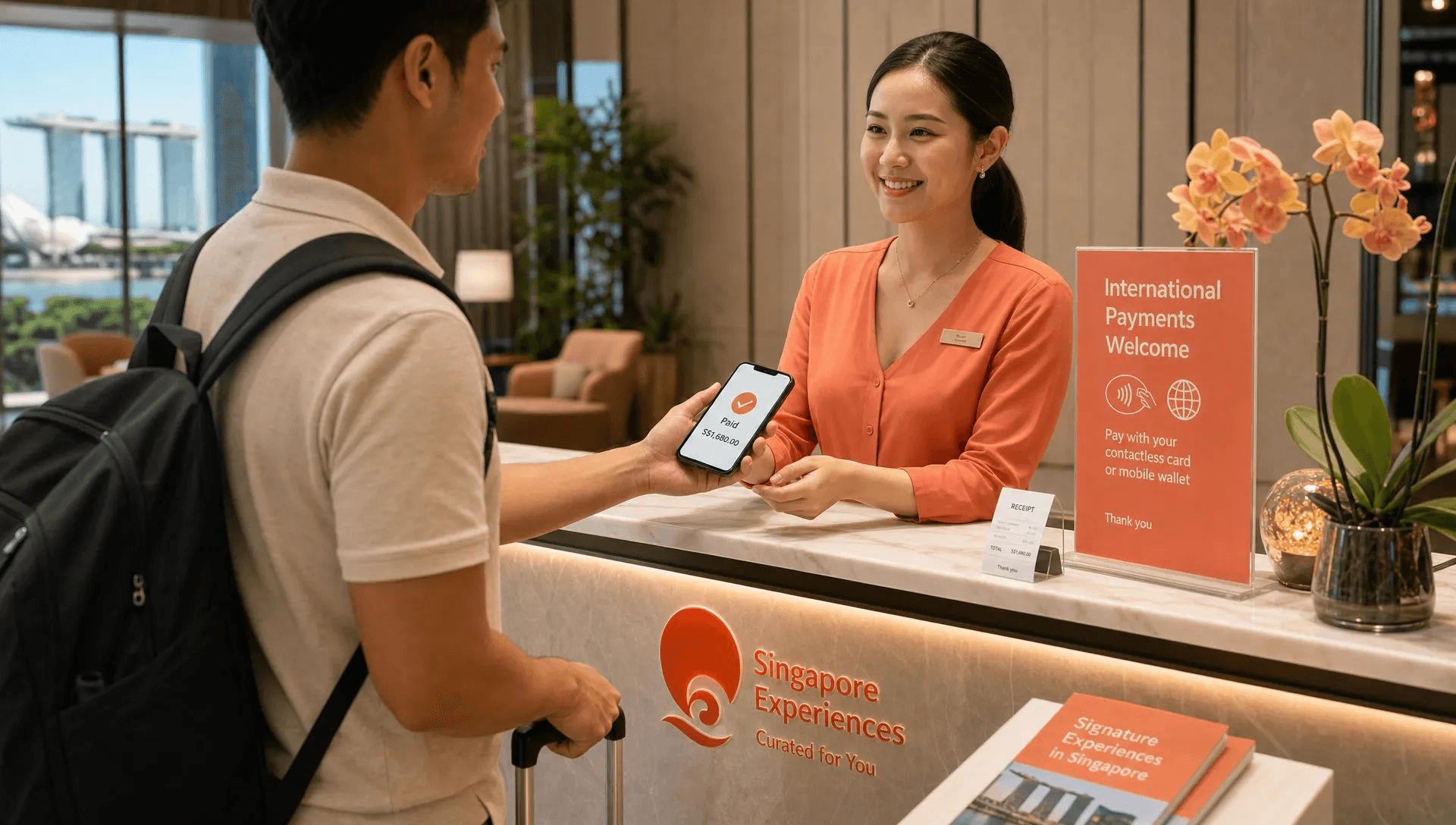
PayNow is useful, but it does not solve every payment situation
PayNow should not be dismissed. For many Singapore SMEs, it is still one of the best options for domestic bank transfer payments. It is simple, familiar, and at its core free when used directly through participating banks.
The issue is coverage. PayNow works best when the customer has access to Singapore banking. It is less useful when your customer is a tourist, a foreign corporate buyer, an expat who has not set up local banking, or someone visiting Singapore for an event.
That is why small businesses should think in terms of payment fit:
Payment method | Best for | Main limitation |
|---|---|---|
PayNow or SGQR | Local customers with Singapore bank accounts | Not suitable for many international customers |
Cash | Very small transactions or backup situations | Less common for higher-value purchases and travellers |
Local card payments | Singapore-issued Visa, Mastercard, or Amex | Costs more than PayNow |
International card payments | Tourists, expats, overseas clients, regional visitors | Usually higher processing fees than local cards |
For many merchants, the right setup is simple: keep PayNow for local customers, and add card acceptance for customers who prefer or need it. This avoids forcing every customer into one payment method.
The hidden cost of not accepting international cards
Small businesses often focus on card processing fees because those fees are visible. A 3% fee is easy to see on a statement. Lost sales are harder to measure because they quietly disappear.
Imagine a pop-up retailer selling fragrance sets at S$220 each. If two international visitors walk away because they cannot use PayNow and do not want to withdraw cash, that is S$440 in lost revenue. Even after card fees, accepting the sale would likely have been better than losing it entirely.
Or consider a private transport business serving airport arrivals and Singapore to Malaysia transfers. Travellers may arrive without Singapore cash, and they may not have PayNow. Asking them to find an ATM or make a bank transfer later adds friction and risk. Accepting a contactless card at the point of service makes the experience feel more professional and reduces follow-up.
The same applies to mobile service providers. A personal trainer selling a 10-session package, a makeup artist taking payment at a hotel, or a physiotherapist collecting payment after a home appointment may all benefit from letting the customer tap a card on the spot.
The key is to compare card fees against the revenue you would otherwise lose, not against a perfect zero-fee world where every customer can use PayNow.
What fees should Singapore businesses expect?
International card payments typically cost more than Singapore-issued card payments. That is normal across payment providers because overseas card processing can involve cross-border card network costs, card type differences, and additional risk handling.
When comparing providers, look beyond the headline percentage. A small fixed fee can make a big difference on low-value transactions, while the percentage rate matters more on higher-value sales.
Fee component | What it means | Why it matters |
|---|---|---|
Percentage fee | A percentage of the transaction value | Higher-value transactions pay more in absolute dollars |
Fixed transaction fee | A flat fee per payment, such as S$0.30 | Can be expensive for very small purchases |
International card rate | The rate applied to foreign-issued cards | Usually higher than domestic card rates |
Amex rate | The rate applied to American Express cards | Often priced separately by providers |
GST on fees | GST charged on provider fees, where applicable | Some providers add GST separately, so compare total cost |
Settlement timing | How quickly funds reach your bank account | Important for cashflow-sensitive small businesses |
As a reference point, nashi supports Visa, Mastercard, and Amex for in-person card acceptance. Its international Visa, international Mastercard, and Amex pricing is currently 3.3% + S$0.30, while Singapore-issued Visa and Mastercard can be priced lower for selected segments. Pricing should always be checked against your business type, card mix, and average transaction value.
For small businesses, the most useful calculation is your blended cost. If 80% of customers pay by PayNow and 20% pay by card, your overall cost of payment acceptance may still be very manageable, especially if card acceptance helps you close higher-value sales.
Which Singapore businesses benefit most?
International card acceptance is not equally important for every SME. It is most useful when you meet one or more of these conditions: you serve visitors, you sell higher-ticket products or services, you operate away from a fixed counter, or you want a more professional payment experience.
Tourist-facing retailers and pop-ups
Boutiques, fairs, weekend markets, design pop-ups, fragrance brands, skincare businesses, craft sellers, and lifestyle retailers often meet customers who are ready to buy but cannot use local bank transfers. International card payments let them pay the way they would at home.
For event-based sellers, mobility matters too. A traditional terminal may be too expensive or inconvenient if you only sell at a few events a month. A phone-based card acceptance app can be easier to deploy and easier to pack away.
Transport, travel, and cross-border services
Airport transfers, private drivers, pet transport services, and Singapore to Malaysia transport providers frequently serve customers who are not set up for PayNow. Card acceptance can make payment easier at pickup, drop-off, or booking confirmation.
These payments are usually not S$5 micro-transactions. They are often high enough that accepting a card is commercially sensible if it prevents delayed payment or awkward cash handling.
Home and trade services
Air-con servicing, plumbing, rug cleaning, upholstery cleaning, maintenance, and repair businesses often collect payment at a customer’s home or office. A customer may prefer to use a credit card for larger invoices, especially if the job is unexpected or urgent.
For these merchants, card acceptance also signals professionalism. The customer does not need to ask for a UEN, key in a transfer manually, or worry whether the payment went to the right account.
Professional and wellness services
Tutors, tuition centres, fitness trainers, golf instructors, physiotherapists, osteopaths, counsellors, and beauty service providers may sell packages rather than single low-value sessions. When a customer is paying several hundred or several thousand dollars, card preference becomes stronger.
In these sectors, the cost of not accepting cards can show up as delayed decisions. A customer may say they will “transfer later” or “come back after checking,” and the sale becomes less certain.
How to accept international card payments without buying a terminal
Traditionally, accepting card payments meant applying for a merchant account, waiting for approval, receiving a terminal, learning the device, paying rental or subscription fees, and carrying hardware to every selling location.
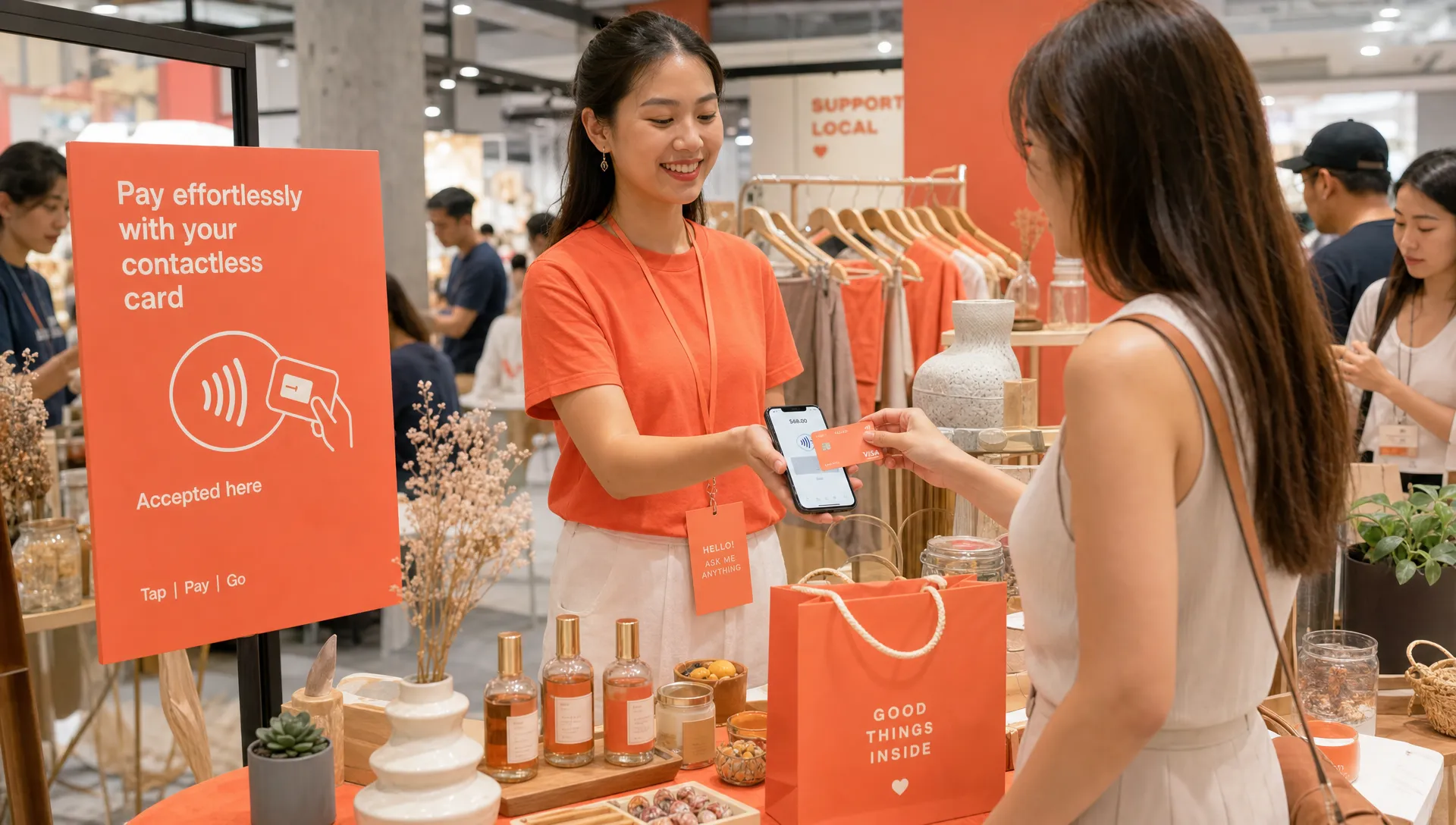
Tap to Phone changes that. Instead of using a separate card reader, the merchant uses an NFC-enabled smartphone as the payment acceptance device. The customer taps their contactless card or mobile wallet on the merchant’s phone, and the payment is confirmed in the app.
nashi is built around this model for Singapore micro and small businesses. It is a free-to-download app that turns an Android phone or compatible iPhone into a card payment terminal, with no Bluetooth reader, plug-in device, or countertop terminal required. On iPhone, Tap to Pay on iPhone works with iPhone XS and newer.
A typical nashi setup looks like this:
Download the nashi app on Android or iPhone.
Complete digital onboarding in the app using your latest ACRA, majority shareholder IDs, and bank statement.
Once approved, usually within 1 business day, enter the amount in the app.
Ask the customer to tap their card or mobile wallet on the back of your phone.
Receive real-time transaction confirmation.
Get automatic payouts to your bank account in 2 business days.
Issue full or partial refunds through the app if needed.
If you want the step-by-step mechanics, nashi has a detailed guide on how to accept card payments on your phone in Singapore.
What to check before choosing a provider
International card acceptance is not just about whether a provider can technically process overseas cards. For a small business, the operational details matter just as much.
First, check supported card types. If you serve international customers, Visa and Mastercard are essential. Amex can also matter for travellers, expats, and corporate customers, particularly in higher-value segments.
Second, check whether you need hardware. A phone-based setup can be more practical for pop-ups, mobile services, and occasional selling. It also avoids terminal rental and the hassle of charging, syncing, storing, and troubleshooting another device.
Third, check onboarding speed. If you are preparing for a fair, event, client appointment, or market weekend, waiting weeks can mean missed revenue. A digital onboarding flow is usually better suited to small businesses than paper forms and manual terminal delivery.
Fourth, check settlement timing. International card payments are not helpful if cashflow becomes unpredictable. nashi settles funds automatically to the merchant’s bank account in 2 business days, which gives small merchants a clear expectation.
Fifth, check compliance and security. Card payments should be handled through a compliant payment environment, not through improvised processes such as photographing card details or asking customers to send card numbers over chat. nashi is PCI-DSS compliant and powered by Adyen’s payment infrastructure. You can read more about the PCI security standard from the PCI Security Standards Council.
Finally, check whether the platform is built for your actual needs. Some payment providers offer online gateways, invoicing, payment links, POS modules, SKU management, and e-commerce tools. Those features can be useful for some merchants, but overwhelming if all you want is in-person card acceptance.
A simple way to decide if international cards are worth it
The decision does not need to be complicated. Start with three numbers: your average transaction value, the number of customers who cannot or do not want to use PayNow, and your gross margin.
If your average sale is low and nearly every customer is local, PayNow may cover most of your needs. If your average sale is high, your customers include tourists or overseas clients, or your business operates on the move, card acceptance can quickly become worthwhile.
Use this simple decision table:
Business situation | International card payments likely worth it? | Reason |
|---|---|---|
S$5 to S$10 low-margin purchases | Often no | Fixed fees and MDR may be too high relative to ticket size |
S$100+ retail purchases at pop-ups | Often yes | Overseas visitors may buy immediately if card payment is available |
S$300+ service packages | Often yes | Customers may prefer credit cards for cashflow and rewards |
Businesses serving tourists or expats | Yes | PayNow coverage is limited for non-local customers |
Local-only microbusiness with low-value invoices | Maybe | PayNow may be enough unless customers ask for cards |
You do not need to force every customer onto cards. In fact, the most cost-effective strategy may be to offer PayNow for local customers and cards for those who prefer them.
Common mistakes to avoid
One common mistake is assuming that “Singapore is cashless” means every customer can use PayNow. Singapore residents may be comfortable with PayNow, but overseas visitors often are not.
Another mistake is comparing only the cheapest possible payment method. PayNow may cost less, but a customer who cannot use PayNow is not choosing between PayNow and card. They are choosing between paying by card, finding cash, delaying payment, or not buying.
A third mistake is buying hardware before confirming usage. If you only need card acceptance for occasional events, mobile appointments, or higher-value customer requests, a phone-based solution may be enough.
The final mistake is ignoring refunds. International customers may need partial refunds, changes, or cancellations. A provider that supports refunds through the app can reduce admin work and make the business look more credible.
How nashi fits into the payment mix
nashi is designed for Singapore micro and small businesses that want to accept in-person card payments without turning their operations into a full POS project. It is not an e-commerce platform, inventory system, or super app. It is focused on card acceptance only.
That focus is useful if you already use PayNow, invoices, Shopify, spreadsheets, or a lightweight sales process, but need a simple way to accept cards face to face. You can keep your existing setup and add cards where they make sense.
For international card payments, nashi gives small businesses a practical way to accept Visa, Mastercard, and Amex using a phone. There are no monthly subscription fees, no annual contracts, and no terminal purchase required. For businesses that sell intermittently, travel to customers, or operate at pop-ups and events, that lower commitment can be the difference between trying card acceptance and avoiding it altogether.
Frequently Asked Questions
Can Singapore small businesses accept international card payments without a card terminal? Yes. With a Tap to Phone app such as nashi, an NFC-enabled Android phone or compatible iPhone can accept contactless card payments without a separate terminal or card reader.
Do international customers need PayNow to pay a Singapore business? No. If your business accepts cards, international customers can usually pay with a contactless Visa, Mastercard, Amex, or compatible mobile wallet. PayNow is mainly useful for customers with participating Singapore bank accounts.
Are international card payments more expensive than local card payments? Usually, yes. Foreign-issued cards often carry higher processing costs than Singapore-issued cards. The exact fee depends on the provider, card type, and pricing structure.
Should I stop accepting PayNow if I start accepting cards? No. For most Singapore small businesses, PayNow and card payments work best together. PayNow can remain your low-cost local option, while cards help you serve customers who prefer cards or cannot use PayNow.
How quickly can a small business start accepting cards with nashi? nashi onboarding is digital and typically approved within 1 business day after the required documents are submitted. Once approved, you can accept in-person card payments through the app.
Make it easier for international customers to pay
If your Singapore business serves tourists, expats, overseas clients, pop-up shoppers, or mobile service customers, international card payments can help remove friction at checkout.
nashi lets you accept Visa, Mastercard, and Amex on your phone with no extra hardware, no monthly subscription fees, and automatic payouts in 2 business days. Keep PayNow for local customers, and add cards for the customers who need them.


