
nashi Team
5 min read

Boutiques Singapore is one of the most anticipated design events on the Singapore calendar. It runs twice a year at the F1 Pit Building, drawing over 35,000 visitors per edition. For independent brands, there is no better platform to reach ready, engaged buyers in Singapore.
Getting accepted is just the beginning. Preparation--your booth, your stock, your payments--determines the outcome. The logistics are easy to underestimate.
Returning vendors who prepare properly consistently outperform those who coast on experience. This is the complete preparation checklist, whether you are applying for the first time or returning.
What is Boutiques Singapore?
Boutiques Singapore is a curated design fair that champions independent, original, and socially responsible brands. It has been running since 2002. Two editions take place each year: the Spring Summer Edition (typically May) and the Gifting Edition (typically November).
The next edition--The Gifting Edition 2026--runs at the F1 Pit Building from 20 to 22 November. Vendor set-up day is 18 November. A Media, Trade, and VIP Preview opens on 19 November.
Public doors open 20 November. Teardown wraps up 22 to 23 November.
More than 300 brands participate per edition, split across Retail, F&B, and the Boutiques Showcase Grant track. The audience is Singapore shoppers, international tourists, trade buyers, and retail organisations. All are actively seeking original, design-forward products--a fundamentally different crowd from a weekend market or shopping mall pop-up.
Why Boutiques is worth the effort
Many brands treat Boutiques as a sales channel. The smarter brands treat it as a brand-building platform.
The event draws press, buyers, and social media coverage at a scale that is hard to replicate independently. Boutiques Singapore generates over $7 million in PR value per edition, with coverage spanning weeks before and after the event. A well-prepared vendor gets sales, followers, press mentions, and potential wholesale enquiries from one weekend.
85% of Boutiques Singapore vendors are Singapore-based. That local density matters. Your customers here actively seek local brands and return for future editions if they love what they find.
Step 1: Apply early--and apply right
Applications are free and must be submitted through the Boutiques website. Boutiques does not accept applications via email, DMs, or any other channel. The application process involves four stages: account creation, brand profile, event selection, and your brand application.
Curation is competitive and happens progressively. Earlier applicants are reviewed first. Successful applicants for the Gifting Edition 2026 will be notified by 30 September 2026.
On the waitlist, Boutiques will only contact you if a confirmed vendor pulls out and your brand suits that vacancy.
Three categories are open for application. Retail covers women's and men's fashion, jewellery, accessories, beauty, gifts, lifestyle, home decor, art, and children's products. F&B covers pre-packaged and ready-to-serve food and drinks--savoury, sweet, alcoholic, and non-alcoholic.
The Boutiques Showcase Grant is a separate track for Singapore-registered designers who have not shown at Boutiques before. Your business must be under three years old to qualify.
What Boutiques looks for
Boutiques is explicit about its curation criteria. They want brands with original, creative, quality design and a strong brand story grounded in socially responsible practices. They look for a clear visual merchandising vision: your booth's look and feel, not just its products.
Before you apply, prepare the following:
Professional product images--print-ready quality, well-lit, styled to reflect your brand
Wide layout photos of previous event or store displays (not close-up product shots)
Details of any exclusive launches you plan for the fair
A concise brand story that communicates your values and niche clearly
The strength of your application materials directly affects your chances. Boutiques will not curate a brand they cannot picture on their fair floor. Inconsistent photography or cluttered display images will cost you at the curation stage.
The Boutiques Showcase Grant
If your Singapore-registered business is under three years old, consider the Boutiques Showcase Grant. It provides a subsidised booth, social media coverage, press mentions, and mentorship from the curatorial team. Selection is rigorous and grants are limited.
For qualifying brands, it is one of the most valuable accelerators in Singapore's independent design scene.
Step 2: Plan your stock and inventory
Once you are accepted, your most important operational decision is how much stock to bring. Too little and you miss peak sales hours. Too much and you are paying to move boxes you will not sell.
Use previous sales data if you have it. At other Singapore pop-up fairs, your average units sold per hour is a good baseline. Boutiques draws higher foot traffic than smaller fairs, so factor that in.
Multiply your baseline by event duration--10 hours Friday/Saturday, 8 Sunday--and build in a buffer.
Boutiques Singapore spans three floors. Build-up and wind-down periods on each day are busy. Restocking mid-day without a clean system costs you time and attention.
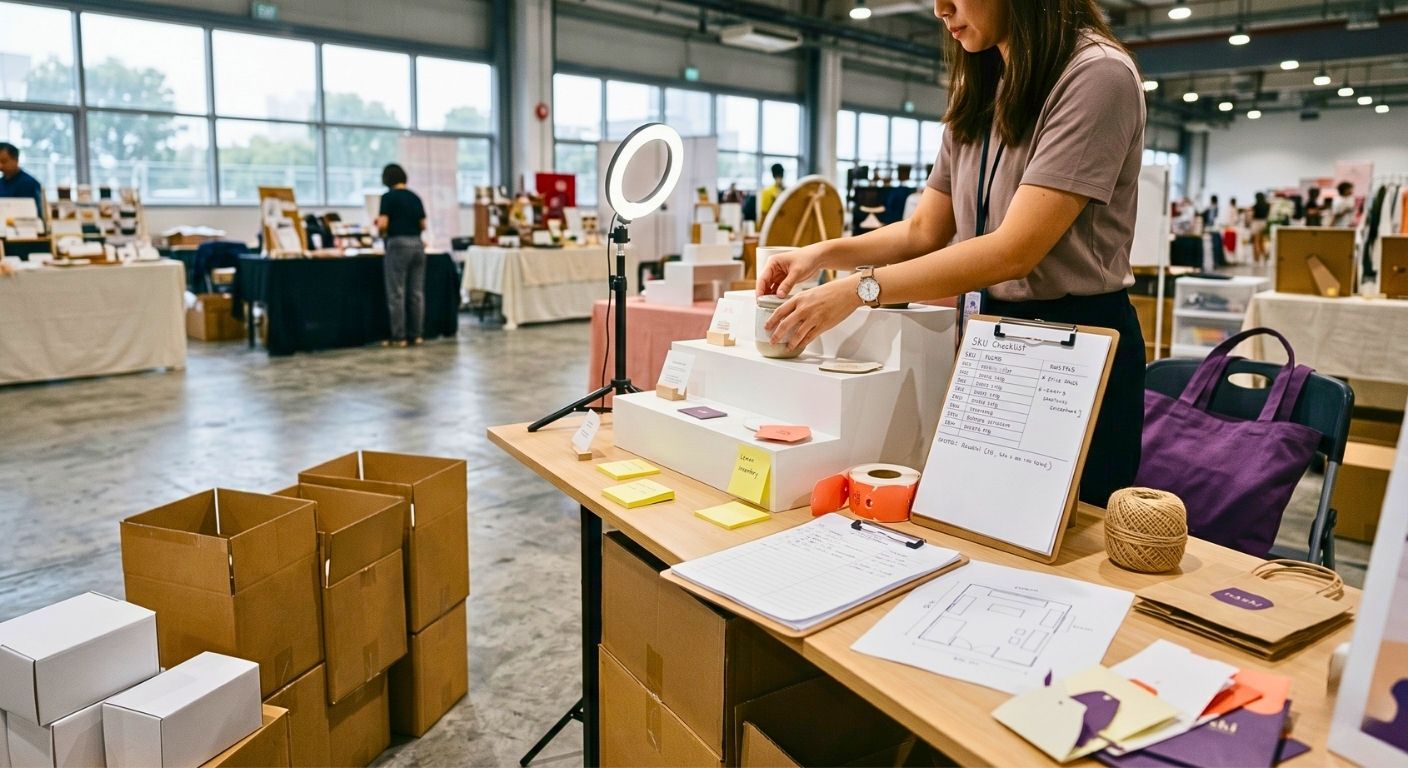
Before you pack, produce a complete stock list by SKU--every product, every size, every variant. Organise boxes so refill stock is accessible without dismantling your display.
Mark every product clearly. Legible pricing visible from browsing distance reduces the number of times you interrupt a customer's consideration. Price tags consistent with your brand aesthetic signal professionalism.
Have a plan for unsold inventory before the fair starts. Decide in advance whether you take everything back or discount on the final day. A clear end-of-event plan makes teardown faster.
Step 3: Design a booth worth stopping at
At Boutiques Singapore, every brand around you is also design-forward and well-curated. Your booth needs to earn a stop from shoppers who could just as easily walk past.
The smallest booth size available is 2m wide by 3m deep. That is a modest footprint. Work it deliberately--every element, from height to signage to lighting, needs to serve a purpose.
Visual merchandising principles
Less is consistently more in pop-up retail display. A crowded booth signals lower value and makes it hard for any single product to command attention. Leave breathing room between products.
Use height. Flat table-only setups read as market stalls. Risers, rail displays, and hanging elements create visual dimension visible from across the room. They draw shoppers in before they reach your booth.
Use your back wall--it is your largest branding surface. A strong backdrop communicates your brand identity at a glance. Your display should tell the story of who you are and what you make.
Lighting
Do not assume venue lighting will be sufficient--indoor fair lighting is rarely flattering for retail displays. Portable LED panels or battery-powered spotlights are worth bringing. A well-lit product consistently outsells the same product under flat overhead lighting.
Your hero products
Put your bestsellers at eye level, at the front of the booth. A striking hero product visible from the aisle gives shoppers a reason to stop in the first two seconds. Once they stop, they browse the rest.
Step 4: Sort your payments before the fair
Payment setup is the most overlooked part of fair preparation--and one of the most costly mistakes to make.
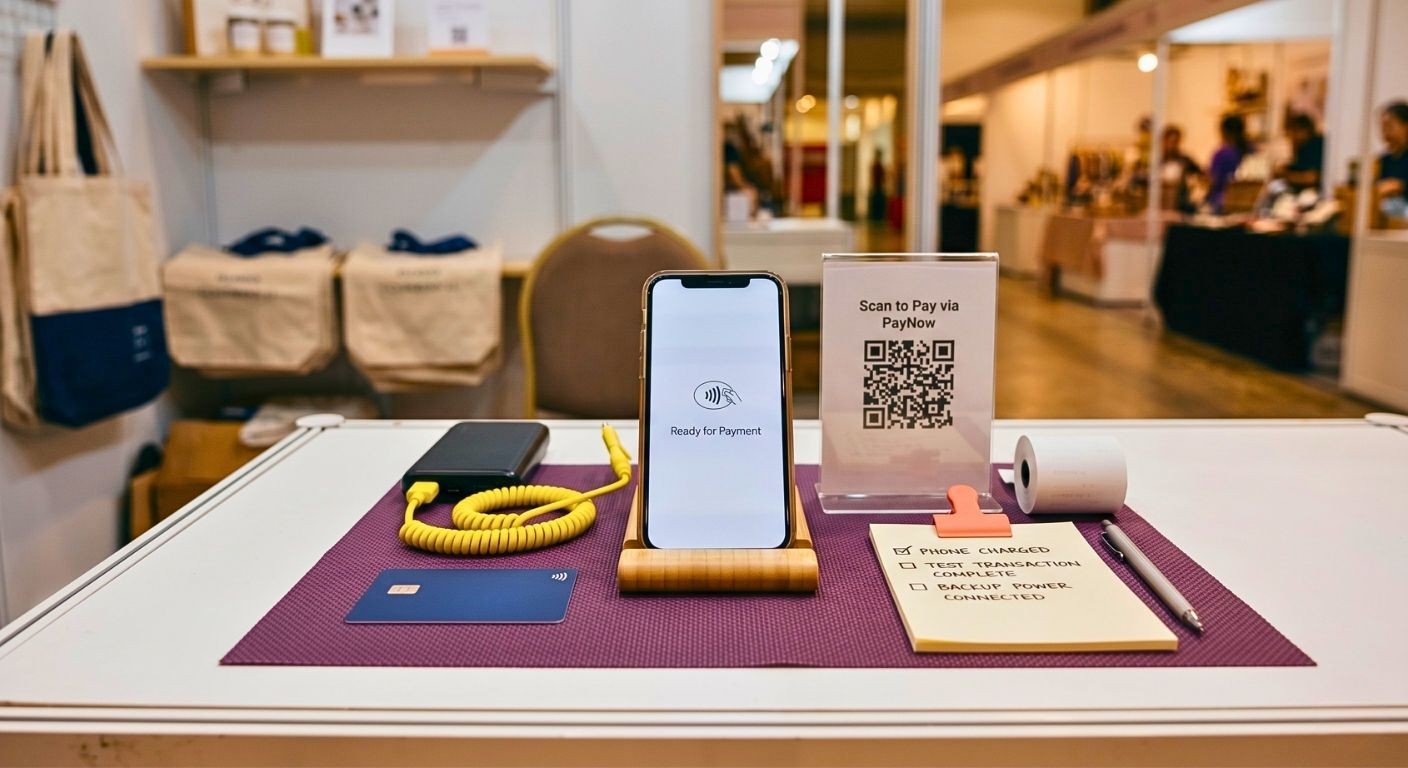
Boutiques Singapore is largely cashless. The event recommends shoppers bring a card or enable PayNow. If you cannot accept cards at your booth, you will lose sales--no polite way to say it.
Most Boutiques shoppers are not carrying cash. They will tap or scan. If your booth cannot accommodate that, they will move on to the next stall that can.
What you need to accept
At minimum, set up:
Visa and Mastercard - the most common cards in Singapore
PayNow - widely used by local shoppers; accept it via your bank app
Amex - important if your products are in the mid-to-high price range, as international visitors frequently carry Amex
Why traditional card terminals are a poor fit for pop-ups
Renting a traditional EDC terminal for a three-day fair rarely makes sense. They involve rental fees, paperwork, and are tethered to a counter. Bluetooth card readers add portability but introduce another device to charge and troubleshoot.
For pop-up merchants, Tap to Phone is the better solution. Your smartphone becomes the card terminal. No extra hardware, no dropped Bluetooth connections, no monthly rental costs.
nashi is a Tap to Phone app built for Singapore businesses. Digital KYC is fully in-app and typically approved in one business day. Accept Visa, Mastercard, and Amex on Android--rates from 1.99% + $0.30, no monthly fee.
Disclosure: nashi is our own product. We've included it here because we believe it genuinely belongs in this recommendation, but you should know we're not a neutral party.
nashi is powered by Adyen's infrastructure and is PCI-DSS compliant, with payouts to your bank in two business days. Full and partial refunds are handled in the app. New merchants get a free trial of up to $1,000 in fee-free transactions.
(nashi is currently Android-only; Tap to Pay on iPhone support is coming soon. If you are on iPhone, HitPay and Revolut Business both offer iOS Tap to Pay in Singapore.)
Set up payments at least five business days before the event. Give yourself time to complete onboarding, run a test transaction, and confirm payouts are wired to the right bank account.
Step 5: Plan your logistics and setup day
The Gifting Edition 2026 vendor setup begins on Wednesday, 18 November 2026. The public event runs Friday to Sunday. Teardown is on Sunday evening and Monday.
Your setup day is as important as your selling days. Merchants who arrive prepared consistently outperform those still figuring out their display when doors open.
What to confirm before setup day
Contact the Boutiques team after you are confirmed to find out:
Your exact booth number and floor
Move-in times and loading access
What is included with your booth (tables, chairs, rails, electricity) and what you need to bring
Electricity access--if you need power for lighting, confirm this in advance
Note on parking: Public parking is not available at the F1 Pit Building. Millenia Walk is a short walk away and has accessible parking. Plan your loading logistics around that, especially if you have a heavy booth kit.
The booth kit you should pack
Build a dedicated kit for every fair. Include:
Tape (double-sided and regular), scissors, and cable ties
A power board and extension cords
Portable battery chargers--at least two (one for your payment device, one spare)
Spare price tags and labels
A level for checking display alignment
A basic toolkit--screwdriver, hammer, and clips for any assembly
Paper towels and wipes for keeping displays clean throughout the day
Small items like these are invisible when you have them. They are catastrophic when you do not.
What to bring for each selling day
Float - Have some small notes and coins, even at a cashless event. A small number of shoppers will still try to pay cash.
Packaging - Branded bags, tissue paper, or boxes. Packaging is part of the brand experience.
Water and food - You will be standing for eight to ten hours. Pack something you can eat quickly at the booth.
A notebook - Capture customer email addresses, Instagram handles, and feedback. This is your customer acquisition channel for after the fair.
A portable charger - Your payment device is your revenue source. Keep it charged.
Step 6: Market yourself before the doors open
Boutiques Singapore generates strong organic foot traffic from its own marketing and press coverage. But the brands that perform best have usually been building anticipation among their own audience well before the fair opens.
Start posting as soon as your participation is confirmed. Tag @boutiquefairssg and tell your audience what you are bringing and where to find you. Boutiques shoppers plan their visits--give them a reason to seek your booth out.
Once you have your booth number, share it. A simple post, "Find us at Booth 2B-07 this weekend," is enough to turn an existing follower into an in-person customer.
Content to create before the event
Exclusive launch teasers - If you are launching a new product or collection exclusively at Boutiques, build anticipation with preview posts in the week leading up
Behind-the-scenes - Packing your booth, making your products, selecting your display pieces; this content is highly shareable and builds personal connection
Pre-event promotions - A limited offer for the first visitors to find you at the fair drives early booth traffic
During the event
Post real-time Stories throughout the fair days. Show your booth, your products, and yourself. Boutiques shoppers who haven't yet come will see your content and make the trip.
Boutiques is one of the few Singapore events that consistently generates significant press coverage. Outlets like The Honeycombers, The Wellness Insider, and Little Steps Asia cover the fair regularly. If you have a press-worthy angle, reach out to these outlets a week before.
After the fair
Do not go quiet the Monday after. Post a wrap-up, thank your customers, and share photos from the event (with permission).
The people you meet at Boutiques--customers, other vendors, buyers, press--are relationships worth maintaining. The fair is an accelerant. What you do with those connections afterward determines whether this is a one-off weekend or the start of something bigger.
Frequently asked questions
When do applications for Boutiques Singapore open?
Applications for The Gifting Edition 2026 (20-22 November) are currently open at boutiquefairs.com.sg/pages/apply. Successful applicants will be notified by 30 September 2026. Applications are competitive and processed progressively, so apply early.
How much does it cost to be a vendor?
The application itself is free. Booth rental pricing is shared only with accepted vendors. The smallest booth is 2m wide by 3m deep; Grant recipients get a subsidised rate.
Do I need to be Singapore-based to apply?
No. International brands can apply through the general application. However, 85% of Boutiques Singapore vendors are Singapore-based. International applicants need a compelling brand story, products not widely available in Singapore, and strong brand values alignment.
What categories can I apply under?
Retail covers fashion, jewellery, accessories, beauty, gifts, home decor, art, children's products, and stationery. F&B covers food, beverages, artisanal snacks, and desserts. The Showcase Grant is for Singapore-registered businesses under three years old in fashion, art, graphic design, or home design.
How should I handle payments at the fair?
The event is largely cashless. At minimum, set up Visa and Mastercard acceptance before arriving. A Tap to Phone app like nashi turns your Android into a card terminal (no hardware, no monthly fee).
Set up at least five business days before the event. Digital onboarding is typically approved in one business day.
What if I am on the waitlist?
Being waitlisted means you may be offered a spot if a confirmed vendor pulls out. Boutiques will only contact you if your brand suits that vacancy. Apply early in future rounds--waitlist placement does not guarantee participation.
Can I show at both Boutiques Singapore and Boutiques Asia?
Yes. Boutiques also runs a Bangkok edition (Boutiques Asia) with a separate application process. Both events can be managed in parallel if you want regional exposure across Singapore and Southeast Asia.
Conclusion: The fair goes to the prepared
The Gifting Edition 2026 runs from 20 to 22 November. Applications are open now, with notification by 30 September. How you use the window between confirmation and event day determines your results.
Apply early with strong materials. Sort card payments and booth design well before setup day. Stock smartly, market proactively, and build relationships that outlast the weekend.
Boutiques Singapore is one of the most valuable platforms for independent brands in Singapore. The merchants who leave with the strongest results are the ones who took preparation as seriously as the event itself.
If you are setting up card acceptance for the fair, try nashi free. You get up to $1,000 in fee-free transactions, no hardware, and onboarding approved in one business day.


