
nashi Team
5 min read

Fave and nashi both accept payments from Singapore customers. Beyond that, they are built for fundamentally different purposes. Understanding the difference is the only way to know which one belongs in your business.
Fave is a payment and loyalty platform. It combines FavePay — a QR-based cashback payment system — with loyalty tools, marketing reach, and business analytics. Merchants on Fave gain access to the Fave consumer app's user base. That audience discovery is at the core of Fave's value proposition.
nashi is a pure card acceptance tool. It turns an Android phone into a card terminal via Tap to Phone. No hardware, no monthly fee, no loyalty features. The pitch is simple: the lowest rates for in-person card acceptance in Singapore, approved in one business day.
Fave vs nashi: Quick comparison
The table below summarises the key differences before going deeper into each platform.
Fave (FavePay) | nashi | |
|---|---|---|
Type | Payment + loyalty platform | Card acceptance only |
Payment method | Fave QR (app-based) | Tap to Phone (contactless card) |
Accepted cards | Visa, MC + local digital wallets via Fave app | Visa, MC, Amex |
Starting fee | 1% Fave Fee (cashback ≥ 10%) | From 1.99% + $0.30 |
Monthly fee | None | None |
Cashback/loyalty | Yes — merchant funds cashback | No |
Consumer marketplace | Yes — Fave app users | No |
Onboarding | Via FaveBiz app | 1-day digital KYC |
Settlement | By payment cadence | T+2 (2 business days) |
Hardware | None (QR code) | None (NFC-enabled Android) |
Free trial | No | Yes — up to $1,000 fee-free |

Fave: Payment and loyalty for merchants with a repeat-customer model
Fave is an all-in-one merchant platform used by over 30,000 businesses across Singapore and Southeast Asia. At its core is FavePay — a QR-code payment system where customers pay through the Fave consumer app. Alongside payment acceptance, Fave offers cashback loyalty tools, eCards (prepaid gift vouchers), FaveDeal marketing, and business analytics.
The cashback model is Fave's primary differentiator. Merchants set a cashback rate — the percentage they offer customers on each transaction. Fave publishes that cashback offer to its consumer app users. The mechanic is designed to bring customers back. A customer who earns cashback has a clear reason to return and spend it.
The trade-off is cost. On a $100 sale with a 10% cashback offer, a merchant retains approximately $88.91. That breaks down as: merchant cashback ($10), Fave Fee ($1), and 9% GST ($0.09). For merchants offering less than 10% cashback, the Fave Fee rises to 1.8% in Singapore, plus 9% GST. That increases the per-transaction cost even before cashback is funded.
Key features
FavePay: QR-based payment accepted through the Fave consumer app
Cashback loyalty program — merchant sets the cashback rate
eCards: prepaid gift vouchers sold in advance to customers
FaveDeal: promotional deal listings reaching Fave's consumer app users
Business analytics dashboard with customer behaviour insights
Accepts Visa, Mastercard, and major local digital wallets through the Fave app
Available on both Android and iOS
Pricing
Fave Fee: 1% per transaction if merchant cashback ≥ 10%
Fave Fee: 1.8% per transaction if merchant cashback < 10%
9% GST applies on top of all Fave Fees
Merchant funds the cashback separately from the Fave Fee
No published monthly subscription fee
eCards and FaveDeal: pricing available on enquiry
Pros & cons
Pros:
Built-in loyalty mechanic — cashback gives customers a reason to return
Access to Fave's consumer marketplace and active Singapore user base
Business analytics and customer behaviour data included at no extra cost
Accepts a range of e-wallet and QR payment methods
eCards create upfront cash flow by selling vouchers in advance
Cons:
Total cost per transaction is higher than it appears — Fave Fee plus merchant-funded cashback
Customers must use the Fave app to access cashback — limits reach to Fave users
Does not function as a card terminal — cannot accept a Visa or Mastercard tap directly
Settlement timing based on payment cadence, not a fixed T+2 standard
Merchants who skip the loyalty features still pay the Fave Fee on every transaction
Customers
Fave is best suited to brick-and-mortar businesses with regular customers. This includes food and beverage operators, beauty salons, retail shops, and fitness businesses where repeat visits drive revenue. The cashback model works when customers return frequently enough to redeem what they earned. Fave's own data reports a 70% increase in returning customers among active users and a 2.5x lift in non-peak sales. Both figures reflect the loyalty mechanic working as designed. Merchants who are not running active loyalty campaigns effectively pay for a feature they are simply not using.
nashi: Card acceptance at the lowest rates in Singapore
Disclosure: nashi is our own product. We've included it in this comparison because we believe it genuinely belongs here, but you should know we're not a neutral party.
nashi is a Tap to Phone app that turns any NFC-enabled Android phone into a card terminal. No card reader, no Bluetooth accessory, no monthly subscription, no loyalty infrastructure. It exists to solve one problem: accepting Visa, Mastercard, and Amex at the lowest possible cost in Singapore.
Rates start from 1.99% + $0.30 for Singapore-issued Visa and Mastercard. Standard list pricing is 2.4% for businesses new to card acceptance and 2.7% for all other categories. Amex and international cards are accepted at 3.3% + $0.30. There is no monthly fee and no setup fee — you pay only when you process a transaction.
Onboarding is entirely digital and typically completed within one business day. Settlements reach your bank account within two business days. The free trial covers up to $1,000 in fee-free transactions. For most merchants, that is a full market day or service session before any rate applies.
Key features
Tap to Phone on any NFC-enabled Android device
Accepts Visa, Mastercard, and Amex
Fully digital KYC — no paperwork, typically approved in one business day
Automatic payouts to bank account in 2 business days
Full and partial refunds through the app
No hardware, no monthly fees, no lock-in contract
Free trial: up to $1,000 in fee-free transactions
Pricing
Singapore Visa / Mastercard: from 1.99% + $0.30 (eligible segments)
Amex and international cards: 3.3% + $0.30
Standard list pricing: 2.4% (new-to-cards); 2.7% (all categories)
No setup fee, no monthly fee, no cashback obligation
Contact nashi directly to discuss pricing for your business category
Pros & cons
Pros:
Lowest starting rate for in-person card acceptance in Singapore
Accepts Amex — Fave does not support direct Amex card tapping
No monthly fee and no cashback funding obligation
One-day digital onboarding with no branch visits or paperwork
Free trial covering up to $1,000 in fee-free transactions
Cons:
Android only for now — iPhone Tap to Pay support is coming soon
No loyalty program or cashback mechanic built in
No consumer marketplace — you build your own customer base
Not an all-in-one platform — card acceptance only
Customers
nashi is built for sole proprietors and small businesses with fewer than ten employees. Early adopters include fragrance and skincare brands, personal trainers, pop-up market stallholders, private tutors, and logistics providers. The no-hardware setup suits merchants who move between locations — events, clients' homes, gyms, or outdoor markets. For businesses that want card acceptance without committing to a loyalty ecosystem, nashi is the most direct fit.
Fave vs nashi: Head-to-head on what matters most
Total cost per transaction
This is where the two platforms diverge most sharply. nashi charges a single, transparent rate per transaction. Fave charges a Fave Fee, plus 9% GST on that fee, plus the cashback you fund yourself.
On a $100 sale with nashi at the 1.99% + $0.30 starting rate, the merchant pays $2.29. Through Fave with 10% cashback on the same $100 sale, the merchant pays roughly $11.09 total. That breaks down as: $10 cashback, $1 Fave Fee, and $0.09 GST. The cashback is not a fee; it is a loyalty spend. But it is money that leaves the merchant's hands on every transaction.
For merchants who are not running active loyalty campaigns, Fave's cost is harder to justify. At 1.8% plus 9% GST, the effective per-transaction cost exceeds most direct card acceptance rates in Singapore. That applies before counting the merchant-funded cashback on top.
Card type coverage
nashi accepts Visa, Mastercard, and Amex directly via card tap. Fave accepts Visa and Mastercard through its app, alongside local digital wallets. Fave does not support a direct Amex card tap.
The Amex gap matters in specific contexts. Singapore has a large international professional community. Events, upmarket retail, and professional services often draw customers carrying Amex or corporate-issued international cards. nashi covers that segment. Fave does not.
Payment mechanic and customer experience
nashi works with any contactless card. Customers tap their physical card or mobile wallet on your phone. No consumer app is required on the customer side.
Fave works differently. Customers must have the Fave app installed and an active cashback balance to engage with the loyalty mechanic. For regular, returning customers who already use Fave, this is seamless. For first-time customers without the Fave app, it is a standard QR payment. No loyalty benefit — but the merchant still pays the Fave Fee on that transaction.
Loyalty and customer retention
This is the dimension where Fave wins outright. nashi has no loyalty features. It does not give customers a reason to return. nashi processes the payment and that is the end of the relationship between the platform and the customer.
Fave is built around the repeat-visit mechanic. Cashback earned on one visit creates pull for the next. Fave's platform data reports a 70% increase in returning customers among merchants using the loyalty program actively. For businesses where repeat visits drive revenue — a café, a salon, a fitness studio — that is meaningful.
Settlement speed
nashi settles to your bank account within two business days (T+2), consistently. Fave's settlement schedule is based on payment cadence; timing varies and is not fixed at a standard number of days. For merchants who manage cash flow around predictable payout dates, nashi's T+2 is easier to plan around.
Which is better for your business?
Choose nashi if:
You want to accept Visa, Mastercard, and Amex at the lowest rates in Singapore. Your customers pay by card and you do not need a loyalty program built into your payment tool. You are a sole proprietor, pop-up vendor, freelancer, or small business that wants a simple, transparent, hardware-free payment setup.
Choose Fave if:
You run a business with regular returning customers — a café, salon, or fitness studio. The cashback loyalty mechanic is something you will actively use. You want access to Fave's consumer app user base as a marketing and discovery channel. You are willing to fund cashback on every transaction to drive repeat visits.
Consider both if:
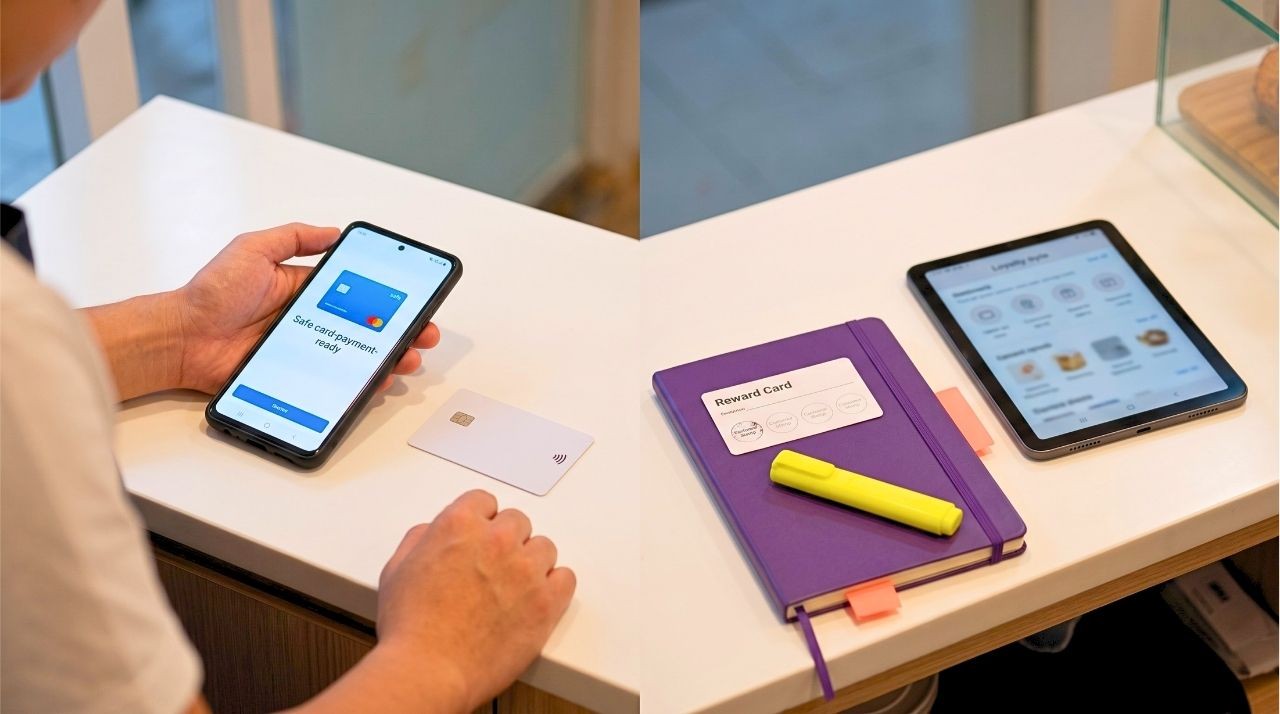
You want card acceptance and loyalty running independently. Use nashi for Visa, Mastercard, and Amex acceptance. Pair it with a dedicated loyalty platform of your choice for the repeat-visit mechanic. This approach keeps your payment cost low while giving you full control over how you run customer retention.
Frequently asked questions
Is Fave a card payment processor?
Not in the traditional sense. Fave is a QR and wallet-based payment platform. Customers pay through the Fave consumer app using Visa, Mastercard, or linked digital wallets. It does not function as a direct card terminal. Customers cannot tap a physical card on your phone or device through Fave.
Can I use nashi if I have a Fave account?
Yes. The two platforms operate independently. nashi handles card tap payments; Fave handles QR-based app payments with cashback. Some merchants run both simultaneously — nashi for card-paying customers, Fave for Fave app users who want to earn cashback. There is no conflict between them.
Does Fave work without the cashback program?
Fave processes payments without cashback active, but the Fave Fee still applies on every transaction. If cashback is set below 10%, that fee rises to 1.8% plus 9% GST. Merchants who disable cashback still pay the Fave Fee — without the loyalty benefit it is designed to fund.
Which platform has lower fees for a $100 transaction?
nashi is lower for pure card acceptance. At the 2.4% standard new-to-cards rate, a $100 nashi transaction costs the merchant $2.40. On Fave with 10% cashback, the same $100 transaction costs $11.09 — $10 in cashback, $1 Fave Fee, and $0.09 GST. That cashback is a deliberate loyalty spend, not purely a fee. But the net merchant payout is considerably less through Fave on every transaction.
Does nashi accept the same payment methods as Fave?
They accept different things. nashi takes Visa, Mastercard, and Amex via contactless card tap or mobile wallet. Fave accepts Visa, Mastercard, and local digital wallets through the Fave consumer app. nashi has the advantage on Amex; Fave has the advantage on local e-wallet QR options. Merchants who need both can use each tool for its strength.
How fast does each platform settle funds?
nashi settles to your bank account within two business days, consistently. Fave's settlement schedule is based on your payment cadence and varies by account. For merchants who need predictable cash flow, nashi's fixed T+2 is easier to plan around.
Conclusion: Different tools, different jobs
Fave and nashi are not true competitors. They serve fundamentally different needs, and the right answer depends on what you are actually trying to solve.
For pure card acceptance — Visa, Mastercard, and Amex at Singapore's lowest rates — nashi is the clearer choice. No cashback obligation, no loyalty ecosystem, no monthly fee. Just card payments, approved in a day, at rates that hold up to scrutiny.
If loyalty and customer discovery matter, Fave offers something nashi does not. The cashback model is proven for businesses where return visits are the primary revenue driver. The trade-off is paying that loyalty cost on every transaction — even from first-time customers who skip the Fave app.
For merchants who want both, running card acceptance and loyalty as separate tools is the most flexible approach. Try nashi free with up to $1,000 in fee-free transactions. Layer in whatever loyalty mechanic fits your customers — entirely separate from payments.


